
Humane Education=Character Education
What is character education?
Character education is generally defined as a means of teaching students core ethical values such as citizenship, respect, justice, and responsibility for self and others. Much like a code of conduct, character education guides students to become useful and caring members of society. Many states require educators to incorporate these values into their lessons, and their inclusion provides a solid ethical foundation that benefits both children and animals.
How does character education help animals?
“Teaching a child not to step on a caterpillar is as valuable to the child as it is to the caterpillar.” —Bradley Miller
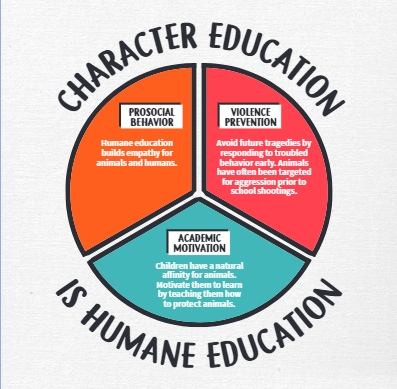
Indeed, children should be taught to revere all living beings as equally deserving of respect and unalienable rights as their peers, parents, and teachers. Character education is an idea that easily translates into animal rights by extending the values of respect and responsibility to animals. Character education is humane education.
Humane education builds empathy for animals and people. Research tells us that empathy is an important contributor to prosocial behavior (Roberts and Strayer, 1996; McDonald and Messinger, 2011). And the prevalence of antisocial behavior in youth is a problem that cannot be overstated (see “Epidemic of Youth Violence Against Animals“). Thus, an approach that builds empathy in students without sacrificing time from the curriculum is urgently needed.
Am I required to teach character education?
Many states mandate that character education be taught in schools. Check below to see if your state is among them. Even without a law requiring character education, most states encourage this type of education in schools, because it’s a logical component of the effort to counter the epidemic of bullying.
Alabama
Act 95-313
“The State Board of Education and all local boards shall develop and implement within ninety (90) days of July 7, 1995, a comprehensive character education program for all grades to consist of not less than ten minutes instruction per day focusing upon the students’ development of the following character traits: Courage, patriotism, citizenship, honesty, fairness, respect for others, kindness, cooperation, self-respect, self-control, courtesy, compassion, tolerance, diligence, generosity, punctuality, cleanliness, cheerfulness, school pride, respect for the environment, patience, creativity, sportsmanship, loyalty, and perseverance.” (Source)
Alaska
Title 14. Education, Libraries, and Museums § 14.03.015
“It is the policy of this state that the purpose of education is to help ensure that all students will succeed in their education and work, shape worthwhile and satisfying lives for themselves, exemplify the best values of society, and be effective in improving the character and quality of the world about them.” (Source)
Arizona
§ 15-719
“A. Each common, high and unified school district and charter school may provide instruction to kindergarten programs through the twelfth grade on character development.”
“B. Each district may develop its own course of study for each grade. At a minimum, the character education program must include: 1. Instruction in the definition and application of at least six of the following character traits: truthfulness, responsibility, compassion, diligence, sincerity, trustworthiness, respect, attentiveness, obedience, orderliness, forgiveness, virtue, fairness, caring, citizenship and integrity.” (Source)
Arkansas
A.C.A.§ 6-15-1005. “Safe, equitable, and accountable public schools. (c) Local schools will work with parents, families, and business and community members to incorporate responsibility, character, self-discipline, civic responsibility, and positive work habits into adult contacts with students and to promote student demonstration of these behaviors.”
A.C.A.§ 6-18-2003. “Comprehensive school counseling program and plan framework. (a) Each public school district shall: (1) Develop and implement a comprehensive school counseling program that ensures student services are coordinated in a manner that provides comprehensive support to all students. The comprehensive school counseling program required under subsection (a) of this section shall: (1) Guide students in academic pursuits, career planning, and social and emotional learning.” (Source)
California
ARTICLE 5. Hate Violence Prevention Act [233–233.8]
“(a) Each teacher shall endeavor to impress upon the minds of the pupils the principles of morality, truth, justice, patriotism, and a true comprehension of the rights, duties, and dignity of American citizenship, and the meaning of equality and human dignity, including the promotion of harmonious relations, kindness toward domestic pets and the humane treatment of living creatures, to teach them to avoid idleness, profanity, and falsehood, and to instruct them in manners and morals and the principles of a free government.”
“(b) Each teacher is also encouraged to create and foster an environment that encourages pupils to realize their full potential and that is free from discriminatory attitudes, practices, events, or activities, in order to prevent acts of hate violence, as defined in subdivision (e) of Section 233.” (Source)
Colorado
§ 22-29-103
“(1) Each school district, either individually or through a board of cooperative services, is strongly encouraged to establish a character education program designed to help students cultivate honesty, respect, responsibility, courtesy, respect for and compliance with the law, integrity, respect for parents, home, and community, and the dignity and necessity of a strong work ethic, conflict resolution, and other skills, habits, and qualities of character that will promote an upright, moral, and desirable citizenry and better prepare students to become positive contributors to society. Such character education program should be designed to stress the importance that each teacher model and promote the guidelines of behavior established in the character education program for youth to follow at all times, in every class.” (Source)
Connecticut
Sec. 10-222q.
“Sec. 10-222q. Social and Emotional Learning and School Climate Advisory Collaborative. (a) There is established a social and emotional learning and school climate advisory collaborative. The collaborative shall (1) collect information concerning the school climate improvement efforts of local and regional boards of education, (2) document any needs articulated by local and regional boards of education for technical assistance and training relating to fostering positive school climates, (3) identify best practices for promoting positive school climates, (4) direct resources to support state-wide and local initiatives on issues relating to fostering and improving positive school climates and improving access to social and emotional learning in schools, (5) develop an assessment for screening students in grades three to twelve, inclusive, to determine whether such students are at risk for suicide, (6) develop a biennial state-wide school climate survey, as described in subsection (c) of section 2 of public act 19-166*, (7) develop a model positive school climate policy, as described in subsection (a) of section 2 of public act 19-166*, (8) develop a plain language explanation of the rights and remedies available under sections 10-4a and 10-4b for distribution to parents and guardians pursuant to subdivision (2) of subsection (c) of section 10-222d, and provide such explanation to each local and regional board of education not later than January 1, 2021, and (9) perform other functions concerning social and emotional learning and fostering positive school climates.” (Source)
Delaware
Code 14-609.4.2 A
“School Based Intervention Program shall include both short term and long term intervention strategies. Such strategies may include character education, short or long term counseling to improve behavior which impacts educational performance, and methods to identify the need to refer students for additional services either within the district or to other agencies. The Program shall also include support services to provide a smooth transition for students who are returning to their regular school from a Consortium Discipline Alternative Program or from a Department of Services to Children, Youth and their Families (DSCYF) setting.” (Source)
District of Columbia
§ 2–1517.32.
“(a) By March 30, 2013, the Mayor shall submit a comprehensive plan to the Council for the expansion of early childhood and school-based behavioral health programs and services by the 2016-2017 school year. At minimum, the plan shall: (1) Establish a strategy to enhance behavioral health services in all public schools and public charter schools, including: (A) The implementation of programs that: (iii) Promote social and emotional competency in students.” (Source)
Florida
§ 1003.42.2(k) Kindness to animals.
§ 1003.42.2(s) A character development program in the elementary schools, similar to Character First or Character Counts, which is secular in nature. Beginning in school year 2004-2005, the character development program shall be required in kindergarten through grade 12. Each district school board shall develop or adopt a curriculum for the character development program that shall be submitted to the department for approval. 1. The character development curriculum shall stress the qualities of patriotism; responsibility; citizenship; kindness; respect for authority, life, liberty, and personal property; honesty; charity; self-control; racial, ethnic, and religious tolerance; and cooperation.” (Source)
Georgia
Code Title 20–Education § 20-2-145
“The State Board of Education shall develop by the start of the 1997–1998 school year a comprehensive character education program for levels K-12. This comprehensive character education program shall be known as the ‘character curriculum‘ and shall focus on the students’ development of the following character traits: courage, patriotism, citizenship, honesty, fairness, respect for others, kindness, cooperation, self-respect, self-control, courtesy, compassion, tolerance, diligence, generosity, punctuality, cleanliness, cheerfulness, school pride, respect for the environment, respect for the creator, patience, creativity, sportsmanship, loyalty, perseverance, and virtue. Such program shall also address, by the start of the 1999–2000 school year, methods of discouraging bullying and violent acts against fellow students. Local boards shall implement such a program in all grade levels at the beginning of the 2000–2001 school year and shall provide opportunities for parental involvement in establishing expected outcomes of the character education program.” (Source)
Hawaii
Character Education Policy 101-2
“The vitality and viability of our democratic way of life are dependent on all students developing into responsible and caring citizens who respect themselves, others, and the world in which they live. Character education is the process through which students are provided opportunities to learn and demonstrate democratic principles and core ethical values, including civic responsibility, compassion, honesty, integrity, and self-discipline.” (Source)
Idaho
IDAPA 08.02.03.23
“Student Learning Goals (Outcomes). Statements describing the general areas in which students will learn and achieve. Student learning goals typically reflect what students are expected to know by the time they leave high school, such as to read and communicate effectively; think critically and solve problems; develop positive self-concept, respect for others and healthy patterns of behavior; work effectively in groups as well as individually; show appreciation for the arts and creativity; demonstrate civic, global and environmental responsibility; recognize and celebrate multicultural diversity; exhibit technological literacy; have a well developed knowledge base which enhances understanding and decision making, and demonstrate positive problem solving and thinking skills.” (Source)
Illinois
§ 105 ILCS 5
“Sec. 27-260. Environmental education. (a) In every public school there shall be instruction, study and discussion of current problems and needs in the conservation of natural resources, including but not limited to air pollution, water pollution, waste reduction and recycling, the effects of excessive use of pesticides, preservation of wilderness areas, forest management, protection of wildlife and humane care of domestic animals.” (Source)
“Sec. 27-12. Character education. Every public school teacher shall teach character education, which includes the teaching of respect, responsibility, fairness, caring, trustworthiness, and citizenship, in order to raise pupils’ honesty, kindness, justice, discipline, respect for others, and moral courage for the purpose of lessening crime and raising the standard of good character.” (Source)
Indiana
IC 20-30-5-6 Good citizenship instruction
“(b) As used in this section, ‘good citizenship instruction‘ means integrating instruction into the current curriculum that stresses the nature and importance of the following: (6) Possessing the skills (including methods of conflict resolution) necessary to live peaceably in society and not resorting to violence to settle disputes. (9) Treating others the way the student would want to be treated.” (Source)
IC 20-26-15-8 Character Education
“(5) A school by school strategy, including curriculum, in which character education is demonstrated to be a priority. The strategy required under this subdivision must include the following subjects as integral parts of each school’s character education: (E) Respect.” (Source)
Iowa
§ 256.18.1.b
“Schools should make every effort, formally and informally, to stress character qualities that will maintain a safe and orderly learning environment, and that will ultimately equip students to be model citizens. These qualities may include caring, civic virtue and citizenship, justice and fairness, respect, responsibility, trustworthiness, giving, honesty, self-discipline, respect for and obedience to the law, citizenship, courage, initiative, commitment, perseverance, kindness, compassion, service, loyalty, patience, the dignity and necessity of hard work, and any other qualities deemed appropriate by a school.” (Source)
Kansas
Article 32. – School Curriculum, 72-3231: Character development programs
“(a) Upon request of a school district, the state board shall assist in the development of a grade appropriate curriculum for character development programs which may be offered to students in the school district. Nothing in this subsection shall be construed as requiring the state board to develop a new curriculum or a new character development program.”
“(b) As used in this section: (1) “Character development program” means a program which is secular in nature and which stresses character qualities. (2) “Character qualities” means positive character qualities which include, but is not limited to, honesty, responsibility, attentiveness, patience, kindness, respect, self-control, tolerance, cooperation, initiative, patriotism and citizenship.” (Source)
Kentucky
§ 158.005
“[C]haracter education’ means instructional strategies and curricula that: (1) Instill and promote core values and qualities of good character in students including altruism, citizenship, courtesy, honesty, human worth, justice, knowledge, respect, responsibility, and self-discipline; (2) Reflect the values of parents, teachers, and local communities; and (3) Improve the ability of students to make moral and ethical decisions in their lives.” (Source)
Louisiana
RS 17:§282.2, Character education programs
“A. The legislature further finds that character education must be augmented and reinforced by public schools in order to prepare students to be productive, self-sufficient citizens who can ably assume societal responsibilities. B. Clearinghouse information shall include information about comprehensive character education programs or curricula, which focus on the development of character traits such as honesty, fairness, and respect for self and others.” (Source)
Maine
Chapter 11, Title 20, Sec 1221, Teaching of virtue and morality
“Instructors of youth in public or private institutions shall use their best endeavors to impress on the minds of the children and youth committed to their care and instruction the principles of morality and justice and a sacred regard for truth; love of country, humanity and a universal benevolence; the great principles of humanity as illustrated by kindness to birds and animals.” (Source)
Maryland
§ 7–306.a.2
“(a) (1) In this section, ‘restorative approaches’ means a relationship-focused student discipline model that: (i) Is preventive and proactive; (ii) Emphasizes building strong relationships and setting clear behavioral expectations that contribute to the well–being of the school community; (iii) In response to behavior that violates the clear behavioral expectations that contribute to the well–being of the school community, focuses on accountability for any harm done by the problem behavior; and (iv) Addresses ways to repair the relationships affected by the problem behavior with the voluntary participation of an individual who was harmed. (2) ‘Restorative approaches’ may include: (i) Conflict resolution; (ii) Mediation; (iii) Peer mediation; (iv) Circle processes; (v) Restorative conferences; (vi) Social emotional learning; (vii) Trauma–informed care; (viii) Positive behavioral intervention supports; and (ix) Rehabilitation.” (Source)
Massachusetts
Part I, Title XII, Chapter 69, Section1P
“(a) As used in this section the term ‘safe and supportive schools’ shall mean schools that foster a safe, positive, healthy and inclusive whole-school learning environment that: (ii) integrates services and aligns initiatives that promote students’ behavioral health, including social and emotional learning, bullying prevention.” (Source)
Michigan
Policy on Quality Character Education
“Qualities such as caring, responsibility, respect for oneself and others, fairness, trustworthiness, citizenship, and self-restraint promote a healthy, safe, and supportive learning environment that promotes the primary mission of the school, which is to educate. With effective character development programs, schools can increase academic achievement and prosocial attitudes and behaviors and decrease negative behaviors such as truancy, violence, discipline problems, and bullying.” (Source)
Non-Codified Policy: Social Emotional Learning
“One of MDE’s primary goals as outlined in the state’s strategic education plan is to support the healthy, safety and wellness of all students. The MDE feels Social and Emotional Learning (SEL) is a critical way to achieve this goal. According to the Collaborative for Academic, Social, and Emotional Learning (CASEL), social and emotional learning is the process of developing students’ and adults’ social and emotional competencies–the knowledge, skills, attitudes, and behaviors that individuals need to make successful choices. SEL helps make individuals understand and regulate their emotions, successfully complete goals, take others’ perspective or point of view, develop positive relationships, and make responsible decisions.” (Source)
Minnesota
§ 120B.232 Character development education
“The legislature encourages districts to integrate or offer instruction on character education including, but not limited to, character qualities such as attentiveness, truthfulness, respect for authority, diligence, gratefulness, self-discipline, patience, forgiveness, respect for others, peacemaking, and resourcefulness.” (Source)
Mississippi
House Bill No. 522, Section 1
“This program of character education shall focus on students’ development of the following character traits: courage, patriotism, citizenship, honesty, pride in quality work, fairness, respect for and obedience to the law, respect for others, kindness, cooperation, self-respect, self-control, courtesy, compassion, diligence, generosity, punctuality, cleanliness, cheerfulness, school pride, respect for the environment, patience, creativity, sportsmanship, loyalty, perseverance, friendship, responsibility and self-discipline.” (Source)
Missouri
Social and emotional health education, voluntary pilot project
“1. (1) The department of elementary and secondary education, through its school counseling section, shall be authorized to establish a voluntary pilot program, beginning in the 2020-21 school year, to provide for social and emotional health education in elementary schools in the state. The purpose of the pilot program shall be to determine whether and how to implement an elementary social and emotional health education program statewide.” (Source)
Nebraska
§ 79-725. Character education; principles of instruction; duty of teachers.
“Each teacher employed to give instruction in any public, private, parochial, or denominational school in the State of Nebraska shall arrange and present his or her instruction to give special emphasis to common honesty, morality, courtesy, obedience to law, respect for the national flag, the United States Constitution, and the Constitution of Nebraska, respect for parents and the home, the dignity and necessity of honest labor, and other lessons of a steadying influence which tend to promote and develop an upright and desirable citizenry.” (Source)
Nevada
NAC 389.195.
“2.In addition to the courses prescribed by subsection 1, a course of study in academic achievement, career exploration, and personal and social development is prescribed for pupils in seventh or eighth grade.” (Source)
Social Emotional Learning“The Nevada Department of Education works to equip educators, families, and communities with tools and resources to support students in developing social emotional skills throughout their educational journey.” (Source)
New Hampshire
Part Ed. 306.04.b.(5)
“Character and citizenship, which shall incorporate and encourage: a. Character and citizenship in courses of study; b. A caring educational environment by demonstration of character and citizenship by example; c. Principles of humanity and general benevolence, public and private charity, industry and economy, and truth and honesty with self and others, pursuant to Part 2, Article 83 of the New Hampshire Constitution; d. Fairness, integrity, and justice; e. Civility, respect, courtesy, and human worth; f. Responsibility to oneself and others; g. Community service; and h. The rights and responsibilities of citizenship.” (Source)
New Jersey
§ 18A:35-4.1 (2022)
“Each board of education may teach, by special courses or by emphasis in appropriate places of the curriculum, in a manner adapted to the ages and capabilities of the pupils in the several grades and departments, the principles of humanity as the same apply to kindness and avoidance of cruelty to animals and birds, both wild and domesticated.” (Source)
Designates last Friday in March of every year as “Social-Emotional Learning Day.” Social-emotional learning (“SEL”) is the process through which individuals acquire and apply the knowledge, attitudes, and skills necessary to understand and manage emotions, set and achieve positive goals, feel and show empathy for others, establish and maintain positive relationships, and make responsible decisions (Source)
New Mexico
Multi-Layered System of Supports (MLSS) 2019, L1.9
“School possesses and promotes schoolwide behavioral norms, and explicitly teaches them along with social emotional competencies such as ‘self-awareness,’ ‘self-management,’ ‘social awareness,’ ‘decision making,’ or ‘relationship development skills.’” (Source)
New York
§ 809. Instruction in the humane treatment of animals
“1. The officer, board or commission authorized or required to prescribe courses of instruction shall cause instruction to be given in every elementary school under state control or supported wholly or partly by public money of the state, in the humane treatment and protection of animals and the importance of the part they play in the economy of nature as well as the necessity of controlling the proliferation of animals which are subsequently abandoned and caused to suffer extreme cruelty. Such instruction shall be for such period of time during each school year as the board of regents may prescribe and may be joined with work in literature, reading, language, nature study or ethnology. Such weekly instruction may be divided into two or more periods.” (Source)
§ 801-A
“The regents shall ensure that the course of instruction in grades kindergarten through twelve includes a component on civility, citizenship and character education. Such component shall instruct students on the principles of honesty, tolerance, personal responsibility, respect for others, with an emphasis on discouraging acts of harassment, bullying, discrimination, observance of laws and rules, courtesy, dignity and other traits which will enhance the quality of their experiences in, and contributions to, the community.” (Source)
North Carolina
§ 115C‑81.60
“Character education. (a) Each local board of education shall develop and implement character education instruction with input from the local community. The instruction shall be incorporated into the standard curriculum and should address the following traits: (4) Kindness. – Being considerate, courteous, helpful, and understanding of others; showing care, compassion, friendship, and generosity; and treating others as you would like to be treated.” (Source)
North Dakota
15.1-07-34.
“Youth behavioral health training to teachers, administrators, and ancillary staff. 1. Every two years, each school district may provide a minimum of eight hours of professional development on youth behavioral health to elementary, middle, and high school teachers, and administrators. Each school district may encourage ancillary and support staff to participate in the professional development. Based on the annual needs assessment of the school district, these hours may be designated from the following categories: a. Trauma; b. Social and emotional learning, including resiliency; c. Suicide prevention; d. Bullying.” (Source)
Ohio
Rule 3301-32-01.V (4)
“‘Social and emotional learning‘ is that portion of the curriculum that addresses forming
friendships, mastering a variety of human interactions such as comparing oneself with one’s peers,
and interacting in social situations.” (Source)
Oklahoma
§ 70-1210.229-6
“A. Program of character education. The board of education of every school district in this state may develop and implement a comprehensive program for character education in any single grade or combination of grades, prekindergarten through twelfth. The character education program shall focus on development of character traits in students.”
“B.4. A character education reading list of books that may include, but is not limited to, books that illustrate models of good character and books that relate to the development of good character traits that may be used by schools in a character education program.” (Source)
Oregon
§ 336.067 (1)
“In public schools special emphasis shall be given to instruction in: (d) Humane treatment of animals.” (Source)
Oregon Administrative Rules 581-021-0200
“(4) Character Education is the process of helping students develop and practice the core ethical values that our diverse society shares and holds important. These values include, but are not limited to, respect, responsibility, caring, trustworthiness, justice and fairness, and civic virtue and citizenship.” (Source)
Pennsylvania
2026 Act 2, Section 1511. Subjects of Instruction
“In every elementary public and private school, established and maintained in this Commonwealth, the following subjects shall be taught, in the English language and from English texts: English, including spelling, reading [and], writing, including print, joined italics and cursive handwriting, arithmetic, geography, the history of the United States and of Pennsylvania, civics, including loyalty to the State and National Government, safety education, and the humane treatment of birds and animals.” (Source)
Rhode Island
Non-codified Policy
“The Rhode Island SEL Standards: Competencies for School and Life Success were developed by the Rhode Island Department of Elementary and Secondary Education (RIDE) in response to requests from school administrators, teachers and support professionals. 3B: Individual seeks to understand and demonstrates respect for individuals, including those with diverse backgrounds, cultures, abilities, languages, and identities. 3C: Individual demonstrates empathy for other people’s emotions and perspectives. 5C: Individual evaluates impact of decisions on self, others and the given situation and adjusts behavior appropriately. 5D: Individual considers ethical, safety, and societal factors when making choices and decisions.” (Source)
South Carolina
SECTION 59-17-135. Character education.
“(B) Each local school board of trustees of the State must develop a policy addressing character education. Any character education program implemented by a district as a result of an adopted policy must, to the extent possible, incorporate character traits including, but not limited to, the following: respect for authority and respect for others, honesty, self-control, cleanliness, courtesy, good manners, cooperation, citizenship, patriotism, courage, fairness, kindness, self-respect, compassion, diligence, good work ethics, sound educational habits, generosity, punctuality, cheerfulness, patience, sportsmanship, loyalty, and virtue. Local school boards must include all sectors of the community, as referenced in subsection (A)(4), in the development of a policy and in the development of any program implemented as a result of the policy. As part of any policy and program developed by the local school board, an evaluation component must be included.” (Source)
South Dakota
§ 13-33-6.1. Character development instruction.
“Unless the governing body elects, by resolution, effective for not less than one or more than four school terms, to do otherwise, character development instruction shall be given in all public and nonpublic elementary and secondary schools in the state to impress upon the minds of the students the importance of citizenship, patriotism, honesty, self discipline, self respect, sexual abstinence, respect for the contributions of minority and ethnic groups to the heritage of South Dakota, regard for the elderly, and respect for authority.” (Source)
Tennessee
§ 49-6-1007(a). Character Education
“(a) The course of instruction in all public schools shall include character education to help each student develop positive values and improve student conduct as students learn to act in harmony with their positive values and learn to become good citizens in their school, community, and society.” (Source)
Texas
Sec. 29.906. Character Traits and Personal Skills Instruction
“(a) The State Board of Education shall integrate positive character traits into the essential knowledge and skills adopted for kindergarten through grade 12, as appropriate. (b) The State Board of Education must include the following positive character traits: (2) trustworthiness, including honesty, reliability, punctuality, and loyalty; (3) integrity; (4) respect and courtesy; (5) responsibility, including accountability, diligence, perseverance, and self-control; (7) caring, including kindness, empathy, compassion, consideration, patience, generosity, and charity; (8) good citizenship, including patriotism, concern for the common good and the community, and respect for authority and the law; (c) Each school district and open-enrollment charter school must adopt a character education program that includes the positive character traits listed in Subsection (b).” (Source)
Utah
Utah Code Part 6: Bullying and Hazing
“(2) To the extent that state or federal funding is available for this purpose, school boards are encouraged to implement programs or initiatives, in addition to the training described in Subsection (1), to provide for training and education regarding, and the prevention of, bullying, hazing, abusive conduct, and retaliation.” (Source)
R277-475-3. Patriotic, Civic, and Character Education
“(1) An LEA shall provide instruction for patriotic, civic and character education in the social studies curricula of kindergarten through grade twelve. (2) An LEA shall ensure an educator has responsibility for patriotic, civic and character education taught in an integrated school curriculum and in the regular course of school work.” (Source)
Vermont
16 V.S.A. § 2902.(b) Tiered system of supports and educational support team
“(5) provide all students with a continuum of evidence-based positive behavioral practices that promote social and emotional learning, including trauma-sensitive programming, that are both school-wide and focused on specific students or groups of students.” (Source)
Virginia
§ 22.1-208.01. Character education required.
“Each school board shall establish, within its existing programs or as a separate program, a character education program in its schools, which may occur during the regular school year, during the summer in a youth development academy offered by the school division, or both. The purpose of the character education program shall be to instill in students civic virtues and personal character traits so as to improve the learning environment, promote student achievement, reduce disciplinary problems, and develop civic-minded students of high character. The basic character traits taught may include (i) trustworthiness, including honesty, integrity, reliability, and loyalty; (ii) respect, including the precepts of the Golden Rule, tolerance, and courtesy; (iii) responsibility, including hard work, economic self-reliance, accountability, diligence, perseverance, and self-control; (iv) fairness, including justice, consequences of bad behavior, principles of nondiscrimination, and freedom from prejudice; (v) caring, including kindness, empathy, compassion, consideration, generosity, and charity; and (vi) citizenship, including patriotism, the Pledge of Allegiance, respect for the American flag, concern for the common good, respect for authority and the law, and community-mindedness.” (Source)
Washington
RCW 28A.230.020 Common school curriculum.
“All teachers shall stress the importance of the cultivation of manners, the fundamental principles of honesty, honor, industry and economy, the minimum requisites for good health including the beneficial effect of physical exercise and methods to prevent exposure to and transmission of sexually transmitted diseases, and the worth of kindness to all living creatures and the land.” (Source)
RCW 28A.150.211 Values and traits recognized.
“The legislature also recognizes that certain basic values and character traits are essential to individual liberty, fulfillment, and happiness. These values and traits include the importance of: (1) Honesty, integrity, and trust; (2) Respect for self and others; (3) Responsibility for personal actions and commitments; (4) Self-discipline and moderation; (5) Diligence and a positive work ethic; (6) Respect for law and authority; (7) Healthy and positive behavior; and (8) Family as the basis of society.” (Source)
RCW 28A.300.477, Social-emotional learning committee.
“(1) Subject to the availability of amounts appropriated for this specific purpose, the social-emotional learning committee is created to promote and expand social-emotional learning. Social-emotional learning will help students build awareness and skills in managing emotions, setting goals, establishing relationships, and making responsible decisions that support success in school and life. (2) At a minimum, the committee shall: (a) Develop and implement a statewide framework for social-emotional learning that is trauma-informed, culturally sustaining, and developmentally appropriate.” (Source)
West Virginia
§18-2-13. Character education integration.
“(a) The state board shall establish a comprehensive approach to integrate character education into all aspects of school culture, school functions and existing curriculum.”
“(b) The state board shall require all public schools that operate from preschool to grade twelve to develop and integrate components of character development into their existing curriculum. The schools may incorporate such programs as “life skills”, “responsible students”, or any other program encompassing any of the following components: (2) Caring; (3) Citizenship; (6) Respect.”
“(c) Character education shall be integrated into each public school curriculum by September 1, 2001.” (Source)
Wisconsin
Non-codified Policy
“The Wisconsin Character Education Partnership (WCEP) promotes the intentional, proactive efforts of educators to instill in all Wisconsin’s students, core universal ethical values such as integrity, honesty, fairness, responsibility, and respect for themselves and for others through character education.” (Source)
Wyoming
Non-codified Policy
“The Wyoming Department of Education (WDE) believes in the importance of supporting student and adult mental and emotional well-being as a key driver for academic and career success. To support this the WDE, in partnership with many stakeholders throughout Wyoming, has built THRIVE. The THRIVE (Think through decisions, Respect for others, Inspire action, Value relationships, Elevate Oneself) framework will support districts, schools, and out-of-school providers with building systems and student competencies that support their mental and emotional well-being. The framework is designed to support building student and adult competencies (knowledge, skills, and mindsets) and the conditions for success that adults create to support competencies associated with mental and emotional well-being.” (Source)
How can I teach character education on top of the existing curricular demands?
The good news is that you can foster prosocial and empathic behavior in children while simultaneously meeting rigorous academic standards. Children have a natural affinity for animals; therefore, any curriculum that incorporates animal issues will generate high interest from students. Add a component about how to protect animals in real-world situations and watch students become even more motivated to learn. When your students are motivated, the conditions are ideal for them to practice reading and writing skills that involve the animal-rights issue being discussed.
Does TeachKind offer any resources to help me teach character education?
Since a discussion about animal rights issues and fostering empathy for animals should be part of any program to build character in youth, TeachKind has got you covered.
- Our FREE Share the World kit is perfect for teaching elementary school students about the Golden Rule and the importance of compassion and empathy—as well as reading and writing skills.

- Our FREE Humane Lesson Webinar can help you merge academic skills with compassion.

- Our FREE Lessons and Activities give you the resources that you need to incorporate compassion for animals into your curriculum.
- Order FREE TeachKind materials for your classroom.
- Contact TeachKind for suggestions or advice. We’re also available for presentations to teachers in the Virginia Beach, Virginia, area.
Humane education has the potential to motivate students struggling with a new, demanding Common Core curriculum and to foster compassion for animals that will extend to humans as well.
References
McDonald, N. and Messinger, D. (2011). “The Development of Empathy: How, When, and Why.” In A. Acerbi, J. A. Lombo, and J.J.Sanguineti (Eds.), Free Will, Emotions, and Moral Actions: Philosophy and Neuroscience in Dialogue. IF-Press.
Roberts, W. and Strayer, J. (1996). “Empathy, Emotional Expressiveness, and Prosocial Behavior.” Child Development, 67, 449‒470.